



With hundreds of horses moving through Waikato Thoroughbred Racing’s (WTR) Cambridge training precinct each morning, sharing the surrounding road network safely has long been an important consideration for the Club, New Zealand Thoroughbred Racing, local trainers, riders and the wider community.
That need is becoming increasingly important as Cambridge continues to grow. New residential and industrial development, an increasing number of homes and greater vehicle movements, including increased heavy-vehicle movements,mean the roads surrounding the Cambridge track are significantly busier than they once were, bringing more horses, riders and motorists into contact with one another.
Over recent years, WTR has been working alongside Waipā District Council, Cambridge Chamber of Commerce and other local stakeholders to explore ways to make the roads surrounding the Cambridge Training Centre safer and more predictable for everyone who uses them.
While those conversations have been underway for some time, significant progress has been made over the past 12 months, with a number of practical initiatives starting to be put in play.
WTR COO, Andy Cruickshank says the work recognises both the unique nature of Cambridge and the changing environment around the training precinct.
“Cambridge is the largest training centre in Australasia with over 1200 horses trained oncourse and horses are a very visible part of daily life here, particularly in and around the training precinct early in the morning,” he said.
“At the same time, Cambridge, the town, has grown significantly. There are more houses, people and therefore more vehicle movements on roads that are also being used by horses and riders every day.
“That makes it increasingly important that we continue looking at practical ways to manage those interactions safely as the town grows.”
For the vast majority of motorists, seeing horses on the road is nothing new, and Cruickshank says the consideration already shown by local road users is genuinely appreciated.
“Most motorists are incredibly patient and considerate around horses, and we certainly don’t want this conversation to suggest otherwise,” he said.
“This work is really about making the environment even safer and clearer for everybody, particularly as road usage continues to increase.”
One of the key areas being considered is the introduction of consolidated horse crossing points around the training precinct.
At present, horses may cross roads at a number of different locations depending on where they are travelling to and from. Creating clearly defined crossing areas would help concentrate those movements into more predictable zones, making it easier for both riders and motorists to understand where they are most likely to encounter horses.
“Reducing the number of places horses are crossing the road makes a lot of sense,” Cruickshank said.
“If motorists know there are designated crossing points ahead, they can anticipate what they might encounter, while for riders it creates a more structured and controlled environment. As traffic volumes increase, that predictability becomes even more valuable.”
Enhanced signage is another important part of the programme, with new high-visibility signage designed specifically to be noticeable during the early-morning hours when much of Cambridge’s training activity takes place.
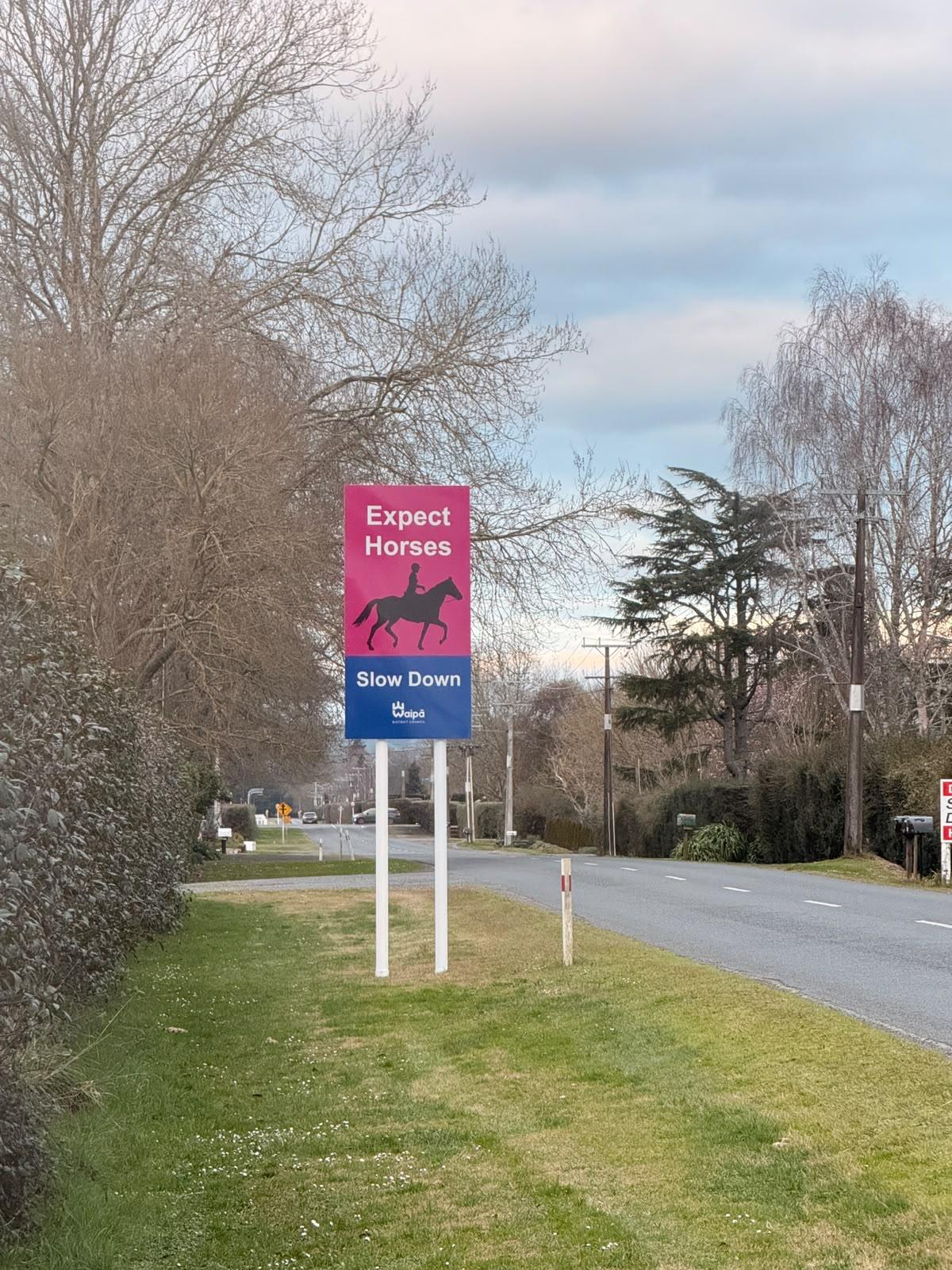
Raised crossing areas have also been discussed as a potential way to naturally reduce vehicle speeds around key horse movements.
“The challenge is not necessarily that people are driving irresponsibly,” Cruickshank said.
“It’s about making sure the road environment itself helps people recognise that they are entering an area where horses may be present and gives them plenty of opportunity to adjust their speed and approach.”
Even experienced racehorses accustomed to regular road movements can react unexpectedly to noise, sudden movement or a vehicle passing too closely.
For motorists approaching horses, the message is straightforward: slow down, leave plenty of room and pass patiently when it is safe to do so.
“A horse can be perfectly relaxed one moment and then react to something none of us anticipated,” Cruickshank said.
“That’s why those few extra seconds of patience are so valuable. Slowing down and giving horses space significantly reduces the risk not only to the horse and rider, but to the motorist and other road users as well.”
Importantly, the responsibility does not sit with motorists alone.
Riders need to remain visible and alert, ride appropriately for the conditions and be considerate of other road users. Trainers and the wider racing industry also have an important role to play in educating riders and continually reinforcing good road-safety practices.
“It has to be a shared responsibility,” Cruickshank said.
“Council can improve infrastructure and signage, we can work with trainers and riders around best practice, and motorists can continue to show the patience and awareness that most already do. When everyone plays their part, it creates a much safer environment.”
Waikato Thoroughbred Racing is grateful to Waipā District Council for its ongoing support and willingness to work constructively with the racing community on the project.
With Cambridge continuing to grow both as a town and as a significant thoroughbred training centre, Cruickshank feels collaboration will remain critical.
“Horses are an important part of Cambridge’s identity, but we’re also part of a busy and growing community,” he said.
“The good thing is that everyone is coming at it with the same perspective. We all want to make the roads safer for horses and their riders but also motorists and the community as a whole.”